


How Long Does It Take to Recharge?
Divide your battery's amp hours (Ah) by your charger's amps. A 100Ah battery takes 10 hours to charge from empty with a 10A charger, or five hours with a 20A charger.
How Long Will a 100Ah Lithium Battery Last in My RV?
Start with the energy it holds. Our 12V 100Ah Sport Series battery (12100G24) is a 12.8V battery, so it stores about 1,280 watt-hours (Wh), and you can use nearly all of it. Divide that by the watts you’re running to get hours. For example, 50W of lights, fans and a water pump running together would take about 25 hours to empty it. Running through an inverter costs some extra power, so plan a little short of the math.
How Many Years Will a Lithium RV Battery Last?
About 10 years. Cycle life depends on how deeply you drain the battery each time: up to 10,000 cycles at 30% depth of discharge, 7,000 at 50% and 5,000 at 80%. A lead-acid battery usually lasts one to two years. That's why every Sport Series battery carries a 10-year warranty.
How Many Years Will a Lithium RV Battery Last?
About 10 years, and more than 3,000 charge cycles. A lead-acid battery usually lasts one to two years. That’s why every Sport Series battery carries a 10-year warranty.
How Much of the Battery Can I Actually Use?
All of it. A Millertech LiFePO4 battery delivers 100% of its rated capacity, compared with 50% to 60% from lead-acid. A 100Ah lithium battery gives you roughly the usable power of two 100Ah lead-acid batteries.
Is Lithium Worth It If I Always Camp With Hookups?
It’s still worth a look, but for different reasons. If you’re always plugged in, you won’t feel the extra run time much. You will notice the weight: our 12V 100Ah weighs 26.55 lb, about a third of a 100Ah AGM. You’ll also skip the water checks and corroded terminals, and you won’t be replacing batteries every few seasons. If you’re starting to think about dry camping, lithium is where it really pays off.
Is the Lithium in My RV Battery the Same as the Lithium in My Phone?
No. Phones and laptops use lithium-ion cells built to pack the most power into the least space. Millertech RV batteries use lithium iron phosphate (LiFePO4), which is widely recognized as one of the most stable lithium chemistries. It gives off no gas while charging, and our batteries are UL certified to UL 1973. (Myths blog; UL certified page)
What Charging Voltage Does a Lithium RV Battery Need?
For our 12V batteries, set the bulk and absorption stage between 14.2V and 14.6V, and never above 14.6V. Lithium doesn’t need a float stage, but a float of 13.5V to 13.8V is fine when you’re plugged into power. With several batteries in parallel, let absorption run at least 20 minutes per battery so they balance.
What Else Do I Need to Change When I Switch?
Two things to check:
- Charger or converter: use one built for lithium. An old lead-acid charger could overcharge a lithium battery, or it may not have enough voltage to charge it fully.
- Terminals: use ring terminals, torqued to 10 ft-lb.
If you're not sure about your setup, call our Support Team at 855-MAX-LITH before you buy.
What Is a Heated Lithium Battery, and Do I Need One?
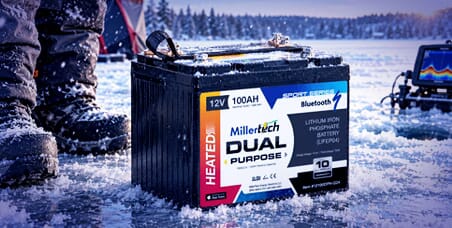
A heated battery has a built-in heater that turns on when the charger is connected and the temperature is below 32°F. It warms the cells to 34°F, then resumes charging. That lets you charge in the cold and fish down to 0°F. If you fish late fall, winter or early spring and keep the boat outside, it’s the one to get.
Heated Sport Series models:
What Size Cables and Fuse Do I Need?
Cable and fuse size depend on the load you're powering, not on the battery. Call our Support Team at 855-MAX-LITH, tell us what you're running, and we'll help you size it.
What Size Inverter Do I Need for My RV?
Add up the watts of everything you’d run at the same time, then choose an inverter rated above that total with room to spare for appliances that surge when they start. Use a pure sine wave inverter for electronics. Millertech carries Edison pure sine wave inverter/chargers with a built-in solar charge controller for 24V and 48V systems.
Why Does My RV Battery Die in Storage When Nothing Is On?
Something is always on. Propane and carbon monoxide detectors, stereo memory and control boards draw a little power around the clock, and over weeks that adds up. Before storage, charge the battery fully, then flip the battery disconnect or remove the cables. A Millertech lithium battery loses only about 1% to 3% of its charge per month on its own, so once it’s disconnected it’ll be ready in spring.
Why Does My RV Panel Say My Lithium Battery Is Only Partly Charged?
Most factory RV panels guess your charge from voltage, and they’re set up for lead-acid. A lithium battery holds a steady voltage almost all the way down, so those panels often read wrong. Trust the Millertech app instead: it reads remaining capacity straight from the battery’s Battery Management System (BMS). If the app also shows the battery isn’t reaching full, your converter may be using a lead-acid charging profile
Why Won’t My Lithium Battery Charge?
Check these four things first:
• Cold: a standard lithium battery won’t take a charge below freezing, to protect the cells. Warm it up or use a heated battery.
• Charger profile: a lead-acid setting may stop short of a full charge.
• Sleep mode: if the battery ran all the way down, the BMS puts it to sleep. Wake it with a lithium charger, a jump pack or another battery that’s at least 50% charged.
• Connections: loose or corroded terminals block charging. Use ring terminals, snug and clean.
Still stuck? Call 855-MAX-LITH. For Sport Series batteries, with your permission, our Support Team can log in through the app and help remotely.
Live search is unavailable. Press Search to load the results normally.
Stil need help?
Call our Support Team. Real people, answering in about 10 seconds. Closed 11:30–12:30 for team lunch, because we take care of our people so they can take care of you.