
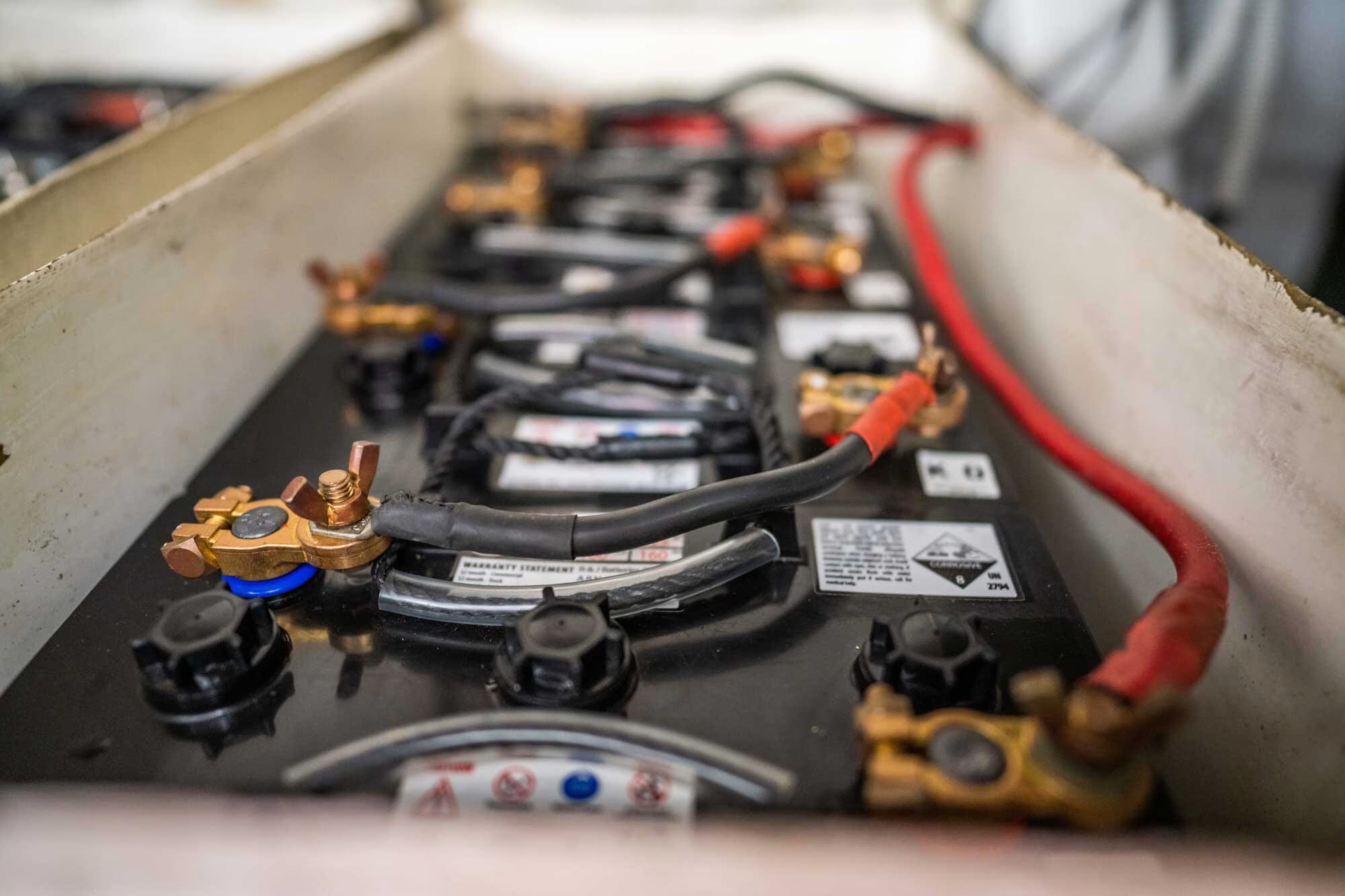
How to Wire Lithium Batteries in Series and Parallel
“How do I connect my batteries in series? How do I connect them in parallel?” We get these questions more than we can count. In this Tech Talk, Lester Miller, Founder of Millertech, heads to our battery testing lab to walk through the difference, how to hook up your charger and trolling motor, which cables to use, and the setup we recommend.
An Easy Way to Remember It
An old friend gave Lester a trick he’s used ever since:
- Parallel sounds like pair. You’re connecting a pair of batteries side by side. The voltage stays the same, and only the capacity goes up.
- Series sounds like serious. The voltage goes up, and that’s serious voltage.
Parallel: Same Voltage, More Amp Hours
In a parallel connection, you connect positive to positive and negative to negative. The voltage doesn’t change, but the amp hours add up. In the video, Lester connects two 36V 50Ah batteries in parallel. The pack is still 36V, but now it holds 100Ah, twice the run time of one battery.
Series: Higher Voltage, Same Amp Hours
In a series connection, you connect negative to positive, battery to battery. The voltage adds up, and the amp hours stay the same. Lester’s example is three 12V 100Ah batteries. Connect two and you have 24V. Add the third and you have a 36V 100Ah pack. Your charger or trolling motor connects to the open positive terminal on one end of the string and the open negative terminal on the other end.
You can connect up to four MillerTech batteries in series or in parallel.
Wiring at a Glance

In series, the charger or trolling motor goes on the two open ends. In parallel, the charger and the motor each connect across both batteries.
Where to Connect Your Charger and Trolling Motor
Series pack. Everything you hook up to the 36V pack, charger or trolling motor, goes from the open positive terminal at one end to the open negative terminal at the other end. That completes the circuit through all three batteries.Parallel pair. You could connect everything to one battery’s terminals and it would work. But Lester recommends crossing the connections so the load is balanced between both batteries:
- Connect the charger’s positive lead to one battery and its negative lead to the other battery.
- Connect the trolling motor to the two terminals that are left, so its leads are also split across both batteries.
The rule of thumb: for any load, coming in or going out, connect it across different batteries.
Use Marine Cable, Crimped RightThe cables between your batteries matter as much as the batteries. Lester compares two:
- 600V welding cable isn’t a bad cable. We use it in our solar systems. But we don’t recommend it on a boat. Its copper strands are bare, with no tinning, so moisture will corrode them quickly.
- MillerTech parallel cables, sold on millertechenergy.com, use tinned strands that resist corrosion. It’s a marine-style cable with a few thousand more strands than the welding cable, so it’s very flexible and easy to route.
How the cable is finished matters too. We hydraulically crimp our cable ends. “We’ve seen so many boats come in with battery issues, and a lot of times it’s bad connections,” Lester says. Don’t crimp cable ends without the proper equipment.
When you install, use ring terminals and torque them to 10 ft-lb.
Three 12V Batteries or a 36V Battery?
For a 36V trolling motor, you can wire three 12V batteries in series, or run one or two batteries that are built as 36V inside. After years of seeing both, MillerTech recommends 36V.Three 12V batteries do have two advantages:
- If your cranking battery dies, you can jump your outboard off one of them.
- If one of the three fails, most trolling motors will still run on 24V from the other two.
But the internals of a 12V battery aren’t made for a 36V system. It works, but over time the batteries age differently. Five, six, or seven years in, the pack is only as good as its weakest battery. If one is slowly losing capacity, the whole pack drops with it.Two 36V 50Ah batteries in parallel give you the same 100Ah. If one of them goes out, you still have a 36V battery to keep fishing on.
You’re never depending on just one.The proof is in our warranty calls. “Since we went to a 36V system, I can say we’ve had probably 99% fewer calls for warranty and problems than we did when we were using three 12Vs,” Lester says. “These batteries are made for 36V inside, and they just go and go and go.”
Questions About Your Setup?
Every boat is wired a little differently. If you’re not sure how to connect your batteries, call 855-MAX-LITH (855-629-5484) and a real person will walk you through it. You can also email [email protected] or visit millertechenergy.com


What Really Matters When You Buy a Bass Boat
Buying a bass boat usually comes down to a budget. Which options can you get, and which ones do you have to pass on? If you’re comparing two boats, one has this and the other has that, so which one works better for you?
Tom Redington has owned more than 20 bass boats and flat bottoms over his fishing career, and he’s fished out of dozens of his friends’ boats too. In the video below, he sorts the options into the ones that don’t matter much and the ones that really do.
Tom’s List at a Glance
| Option | Tom’s Take |
|---|---|
| Top speed | Save your money |
| Bigger graphs | Save, unless you use live sonar a lot |
| Specialty trailer wheels | Save, and stick with stock |
| Boat length | Nice to have |
| Power-Poles | Worth it, and go with 10-foot |
| Trolling motor | Worth it: enough power and the right shaft length |
| Batteries | Number one; don’t skimp |
Where You Can Save
Top speed. Everybody obsesses over it at first. It’s fun to see how fast a new boat goes, and people spend a lot on performance props and tweaks chasing a couple more miles per hour. But going from 36 to 38 mph, or 72 to 74, doesn’t change much on a fishing day. “It matters the first week you have the boat,” Tom says. Unless you love speed, don’t obsess over it.
Bigger graphs. If you use LiveScope a lot, screen size does matter. Moving from a 10-inch to a 12-inch, or a 12-inch to a 16-inch, shows you more detail, and that can help you catch more fish. For maps and regular sonar, though, a 10- or 12-inch screen will suit you fine. Tom downsized his screens on his last boat, and dropping one size can save around $1,000. “I think you’ll be surprised how much you’ll get used to the smaller ones,” he says.
Specialty trailer wheels. Custom wheels may look good, but they take custom tires. In Tom’s experience, his buddies with specialty wheels get more flats. When that happens near some lake far from home, the local tire shop can fix a flat, but it won’t have your size in stock. Stock wheels and tires are universal. “In the long run, you’re going to appreciate it,” Tom says.
Nice to Have: Boat Length
A longer boat rides better in big waves and on long runs. It also gives you more storage and more room on the front deck, which helps with three people aboard. If you fish 7½- or 8-foot rods, you’ll like that the tips aren’t hanging over the end of the deck.
But if you fish alone or with one partner, and you don’t make many long runs, length matters less than you’d think. “An 18-foot boat, a 17-foot boat, a 16-foot boat, it’s going to fish exactly the same as a 21- or 22-foot boat once you get there,” Tom says.
Worth Paying For
Power-Poles. If you fish shallow at all, shallow-water anchors make a big difference, whether you’re docking, sight fishing, or stopping to retie. Tom’s tip is to go with 10-foot poles instead of 8-foot. His boat usually sits in five to eight feet of water. An 8-foot pole can reach that deep, but it won’t hold well at six or seven feet. The 10-foot poles hold every time. Skipping Power-Poles to get bigger screens or an extra foot of boat? “Man, that’s not negotiable,” Tom says.
Trolling motor. On a windy day, in weeds, or fishing into current, a trolling motor without enough power will drive you crazy. Shaft length matters just as much. A taller boat or rough main-lake water calls for a longer shaft that stays in the water and holds you in place. But if you fish shallow and cast under trees or docks, a shaft that’s too long puts the motor head in the way of every cast. “It’s like Shaq standing there trying to block your shot,” Tom says. Get enough power and the right shaft length.
Batteries. Your electronics, trolling motor, Power-Poles, and outboard all depend on them, and for Tom, they matter more than anything. People skimp here all the time with old or undersized batteries. “Nothing kills a trip more than a dead starting battery,” he says. You’re stranded in the middle of the lake because you ran your livewell pumps or graphs all day. Or your trolling motor dies and you’re stuck drifting or sitting in one spot.
“There’s no excuse these days with lithium,” Tom says. Every MillerTech Sport Series battery is backed by a 10-year warranty. It isn’t prorated: if a battery fails, we repair it or replace it at full value, and we pay shipping both ways. The warranty even transfers to the next owner if you sell your boat.
“Get them right to begin with,” Tom says. “You’ll have plenty of battery power, and you can fish as long as you want.” Or, as he puts it, until your elbows and shoulders tell you it’s time to go.
Start With the Power
Save on top speed, screen size, and fancy wheels if you need to. Don’t cut corners on the things that keep you fishing: Power-Poles that hold, a trolling motor that fits your boat, and batteries you can count on from daylight to dark.
Not sure which MillerTech batteries fit your boat? Call 855-MAX-LITH (855-629-5484) and a real person will help you match them to your setup. You can also email [email protected] or visit millertechenergy.com.

Behind the Scenes at MillerTech Headquarters
Ever wonder what happens after you call MillerTech or place an order? In this video, Rick from our team walks through our headquarters in Middlefield, Ohio, with Lester Miller, Founder of MillerTech. From the phones to the repair lab to the loading docks, here’s a look at how we design, build, service, and ship the products you count on.
Where Your Call Goes
The tour starts in tech support. When you call MillerTech with a technical question or a sales question, this is the room that picks up. The people in these offices are the ones who help you solve your problem. Just down the hall is Roman’s office. If you’ve ever had a technical question or a warranty claim, there’s a good chance you’ve talked with Roman. He takes care of all of that for us.
A Showroom You Can Visit
We don’t have a retail store, but we keep one of each product in our showroom. People stop in from all over the US, and from many other countries too. We like having products out where visitors can see them, touch them, and look them over in person.
Made in Our Own Production Area
Our production area builds many of our lighting products and battery-powered products for the Amish community, including items we convert from electric to run on DeWalt and Milwaukee tool batteries.
Some of our hardest workers here are production 3D printers. They run day and night, all year long. As each part cools, a belt moves it forward and drops it into a tote, so the printers keep making parts without anyone standing over them.
Designed in House
Dan, one of our Research and Development (R&D) specialists, creates the 3D and CAD drawings for our batteries and new products. On the tour, he gave a quick peek at a new battery design that hasn’t been released yet. We’re keeping the details quiet for now.The point is that we design our batteries ourselves. We don’t put our name on someone else’s battery. That’s a big part of why we can put a 10-year warranty on our Sport Series batteries and stand behind it.
Batteries Built to Be Repaired
The battery repair and testing room is where Lester says MillerTech really stands out. On the bench during the tour was a battery that had just had its Battery Management System (BMS) replaced. The old BMS was corroded, most likely because the boat flooded and the battery sat underwater too long.
We can make that kind of repair because every MillerTech battery has a lid that opens and closes again. A rubber gasket seals it, and the battery is rated IP67. Those reclosable lids took expensive molds, but they let us open a battery, fix it, and send it back out, often within a day. It doesn’t matter how old the battery is. A bad cell or a bad BMS, we can usually fix it.
The same room has our cycle-testing stations. When new batteries come in, we run them through cycle tests to verify the cells are good. Lester says one charge-and-drain test isn’t enough to judge a battery. “You cannot really test a battery with one cycle,” he says. Our machines can run 500 cycles on their own, and that data shows what kind of cells are really inside.
From Our Shelves to Your Boat
Our 12,000 sq ft warehouse holds about 1,500 pallets of product. That lets us stock up ahead of the spring rush, so batteries are ready when you want to get out and fish.
To fit that much into a small space, we use an Aisle Master, a forklift with an articulating front end. It works in aisles just 6½ feet wide and reaches 26 feet high. Lester looked at robotic systems, but he chose a skilled operator instead. “Some days I feel like too much technology in machines can be a hindrance,” he says. It’s been fast and efficient for us.
When a dealer orders a pallet of batteries, order pickers load a cart for that dealer, and the order is wrapped on a turntable. We use a layer of black wrap first, then heavy-duty clear stretch wrap on top. A pallet of 20 batteries can be worth around $20,000, so an extra $10 of wrap to keep it safe is easily worth it. On average, we ship 15 to 20 pallets a day, mostly with R+L Carriers.
Smaller orders go to the UPS packing station. Each box gets the products, instruction manuals, and a few free goodies. Battery orders can include high-quality parallel cables for connecting two 12V batteries. If you order something small, like a headlamp, it goes out with USPS.
A Few Extras
We also have a laser engraver, run by Tyler, who knows the machine inside and out. We use it to make gifts for the anglers we sponsor, like mugs with our logo and headlamps engraved with each angler’s name. It’s a small way to say thank you.
And when it’s time for a break, there’s a lunchroom with a ping-pong table. The games get pretty competitive some days.
Come See for Yourself
Everything on this tour comes back to one thing: being able to stand behind what we sell. We design our batteries here, test them here, repair them here, and ship them from here.
Have a question about something you saw? Call 855-MAX-LITH (855-629-5484), email [email protected], or visit millertechenergy.com.

All-Day Power on the Ice
All-Day Power on the Ice: The Lithium Solution for Modern Electronics
If you’ve spent any real time on the ice the last few seasons, you already know this: Ice fishing isn’t what it used to be. We’re not just dropping a flasher down the hole anymore. We’re running forward-facing sonar, multiple graph units, GPS mapping, live imaging, LED lighting inside the shack, charging phones, maybe even running a small heater fan or camera system. Modern ice fishing runs on electronics. And electronics run on power. The problem? Most people are still trying to power 2026-level gear with 2005-level batteries. Let’s fix that.

Why Power Matters More Than Ever on the Ice
When you’re fishing open water, you’ve got an alternator charging your batteries. On the ice, once you step off the truck or ATV, whatever power you brought with you is all you’ve got. That changes how you think about your setup. You need stable voltage, enough capacity to last all day, lightweight portability, cold-weather reliability, and confidence that your electronics won’t shut down mid-bite.
That’s where a purpose-built lithium solution like the MillerTech 14.8V 50Ah Marine Electronic Shuttle Battery starts to make a lot of sense.
Let’s Talk Real Numbers (Because They Matter)
This battery is rated at: 14.8 volts x 50 amp hours = 740 watt-hours of energy. That’s a serious amount of usable power in a compact, portable package. To put that into perspective: A typical forward-facing sonar setup may draw around 3 to 5 amps depending on brightness and settings.
A 12-inch graph might pull 2 to 3 amps.
Add lighting and charging devices and you could easily be in the 6 to 8 amp range total.
With 740 watt-hours available, you’re not talking about a few hours. You’re talking about realistic, all-day runtime for most ice setups. And the key word there is usable. Lithium doesn’t sag the way lead-acid does. You don’t lose performance halfway through the discharge curve. Your electronics see stable voltage longer, which means fewer random shutdowns and cleaner screen performance.
Why Voltage Stability Matters on the Ice
This is something most anglers don’t think about until it happens. When voltage drops, electronics start acting strange. Screens dim. Units reboot. Sonar performance drops. Forward-facing systems get unstable. Cold weather makes that worse with traditional batteries. Lithium, especially a properly engineered 14.8V system like this 50Ah unit, holds voltage much flatter under load. That means your electronics perform the same in hour six as they did in hour one. That consistency is everything when you’re dialing in fish.
Built for Electronics — Not Just “Power”
This isn’t a jump pack. It’s not a generic deep cycle battery. It’s designed specifically for electronics-heavy environments. When you’re running sensitive sonar equipment, you want clean, stable output, reliable discharge under load, and smart internal management. This battery includes an integrated Battery Management System (BMS) that protects against over-discharge, over-current, and temperature extremes. With Bluetooth monitoring, you can see exactly what’s happening from your phone — state of charge, voltage, current draw, and battery health. No guessing. No surprises.
Why 14.8V Is an Advantage
Most ice anglers are used to 12V systems. But a 14.8V lithium system gives you a slightly higher nominal voltage, which many modern electronics handle extremely well. In practical terms, that means cleaner power delivery, stronger performance under load, and better compatibility with high-draw marine electronics. It’s a small difference on paper, but noticeable in real-world performance.
Portability Matters on the Ice
Hauling gear across snow is no joke. One of the biggest advantages of this setup is that you get serious capacity without hauling a massive battery bank. The MillerTech 14.8V 50Ah battery keeps things compact, lightweight, easy to mount in a shuttle or electronics box, and easy to transport in a sled. You’re not dragging a marine deep-cycle brick across the lake. You’re carrying smart power.
Cold Weather Considerations
Lithium batteries perform extremely well in cold conditions during discharge, which is what you’re doing all day on the ice. The key best practice is simple: store and charge the battery above freezing when possible. Bring it inside the night before. Charge it in a warmer environment. Then take it out fully topped off. Once you’re on the ice, it will perform consistently throughout the day.
Who This Setup Is Really For
If you’re running a small flasher for a few hours, this battery will handle that effortlessly. In fact, it will power a basic setup exceptionally well with room to spare. But where this battery really shines is in its capacity to grow with you. As electronics continue to evolve, many anglers are adding forward-facing sonar, larger graph displays, GPS mapping systems, LED lighting inside shelters, charging hubs for phones and tablets, and camera systems. The beauty of a 14.8V 50Ah setup is that it doesn’t just cover today’s needs — it’s built for what your setup might look like next season.
Whether you’re keeping things simple or building out a fully dialed electronics package, this battery gives you the confidence that power won’t be the limiting factor.
The Bottom Line
Modern ice fishing demands modern power. When you’re running high-end electronics, stable voltage and real capacity aren’t luxuries — they’re necessities. The MillerTech 14.8V 50Ah Marine Electronic Shuttle Battery delivers 740 watt-hours of usable energy, stable output under load, lightweight portability, smart Bluetooth monitoring, and electronics-focused engineering. All in a package that’s built to handle a full day on the ice. Because the only thing you should be worrying about out there is finding the next fish. Not your battery percentage.
Myth: Lithium batteries can’t handle cold weather
Cold weather affects any battery’s performance, but modern lithium systems use chemistry and management software that keep cells safe even in freezing temperatures. Many include low-temperature charging protection or heating elements. MillerTech batteries are tested in real-world conditions from the Midwest to the mountains, proving that engineered lithium performs regardless of climate.

Busting Lithium Battery Myths
The Truth About Lithium Batteries
If you’ve spent any time around boats, golf carts, RVs, or electric vehicles lately, you’ve probably heard a few strong opinions about lithium batteries. Some people swear by them, others swear at them, and almost everyone has a story they’ve “heard from a friend.”
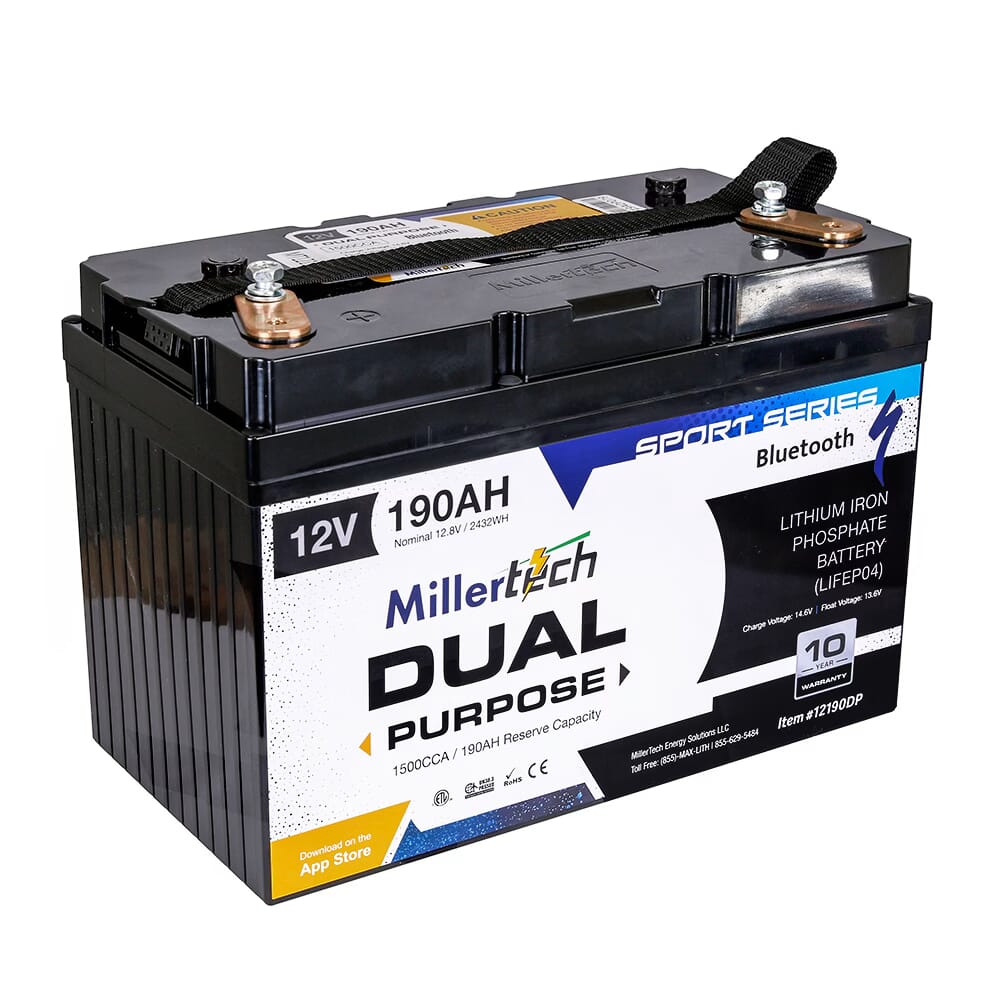
The truth is, lithium technology has come a long way, and a lot of what people still believe about it simply isn’t true. As someone who’s spent years in the fishing, outdoors, and power industries, I’ve seen firsthand how much misinformation still floats around. So today, I want to break down the most common myths and misunderstandings about lithium batteries, and show you why this technology, when done right, is changing everything.
Myth #1: Lithium batteries are unsafe or prone to catching fire
Yes, you’ve seen viral videos of battery fires from cheap e-bikes or knockoff devices. But what people don’t realize is that not all lithium batteries are created equal. Most of those incidents come from poorly designed, unregulated cells with little to no battery management protection.
A properly built lithium battery, like the ones used in marine, golf cart, and EV applications, includes a Battery Management System (BMS) that constantly monitors voltage, temperature, and performance. It shuts things down long before a problem ever becomes dangerous.
MillerTech batteries, for example, use LFP chemistry (Lithium Iron Phosphate), widely recognized as one of the most stable and safest lithium formulas on the market. Read more about Millertech’s safety priorities here.
Myth #2: Lithium batteries don’t last very long
This one might be the most ironic myth out there because lithium batteries actually outlast most traditional lead-acid batteries several times over. A good lithium battery can last 3,000 to 5,000 charge cycles or more. That means years of dependable performance, consistent voltage, and zero need for maintenance or watering. When you break it down by cost per cycle, lithium isn’t more expensive—it’s actually cheaper over time. MillerTech’s lithium systems are a perfect example, engineered for longevity and backed by advanced BMS technology.

Myth #3: Lithium batteries can’t handle cold weather
Cold weather affects any battery’s performance, but modern lithium systems use chemistry and management software that keep cells safe even in freezing temperatures. Many include low-temperature charging protection or heating elements. MillerTech batteries are tested in real-world conditions from the Midwest to the mountains, proving that engineered lithium performs regardless of climate.

All Day Trolling Power
Built for Spring. Ready for All Day.
Spring fishing is here—and your battery shouldn’t be the reason you head in early.
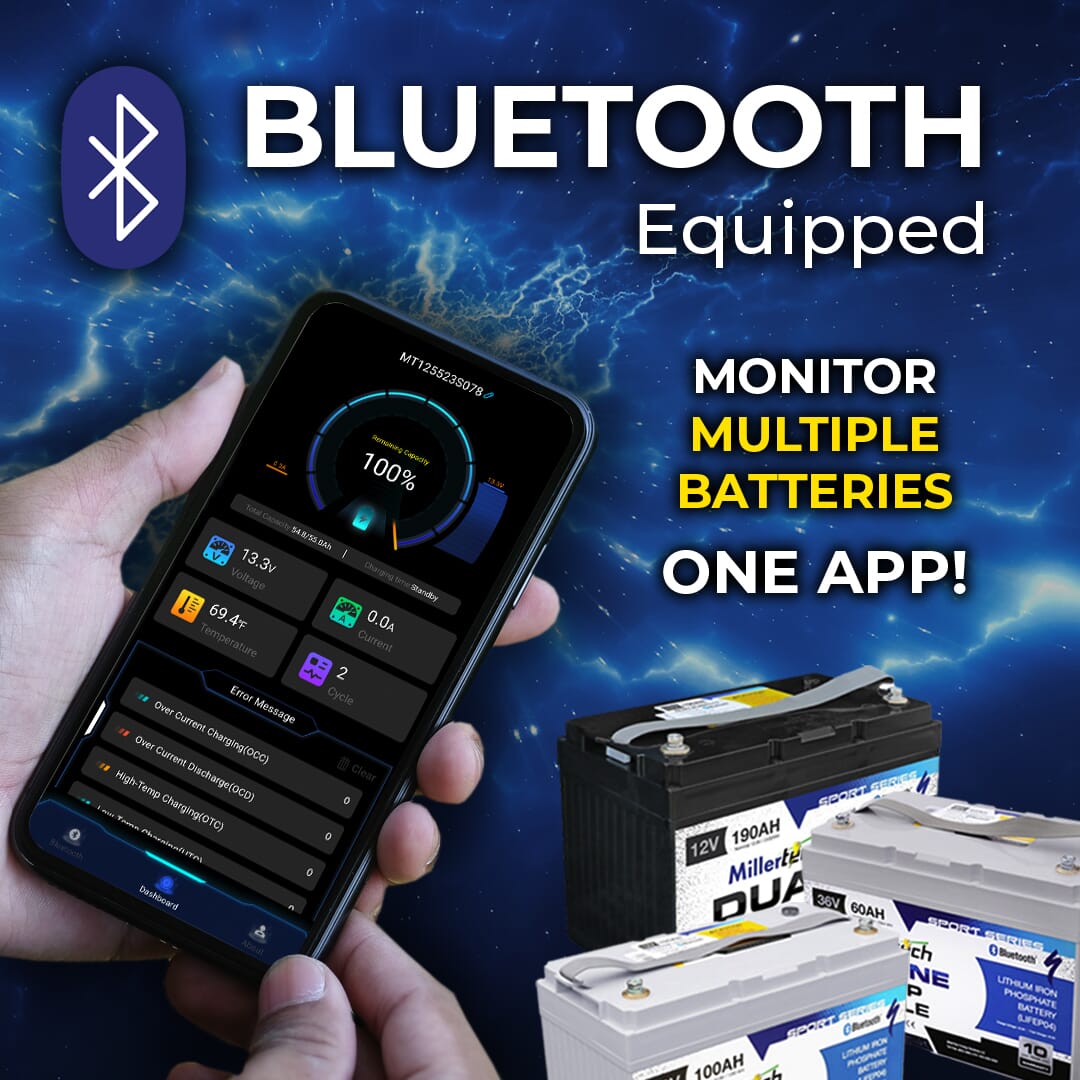
The new 36V 105Ah (Sun Up – Sun Down) Sport Series Lithium Battery is built to power your trolling motor all day long without drop-off, interruption, or mid-day charging. Install it once, run it all day, and trust it every time.
Most batteries are built to hit a price point. This one is built to perform. With 105Ah / 4032Wh of energy, 150A continuous / 300A peak output, Bluetooth monitoring, and low-temp charging protection, it’s designed for real-world use—long days, heavy draw, and changing conditions. Backed by a 10-year no-questions-asked warranty, it’s built to last.


Bigger Ah in Your Lithium Setup
Is Bigger Really Better?
Understanding the Advantages of Bigger Ah in Your Lithium Setup
If you’ve spent any real time traveling in an RV, you already know this: Power changes everything.
It changes how long you can stay somewhere. It changes how comfortable you are. It changes whether you’re enjoying the trip . . . or managing your battery monitor.
One of the questions we hear all the time at MillerTech Energy is:
“Do I really need something like a 560Ah battery, or will a 135Ah setup be fine?” The honest answer?
It depends on how you use your RV.
But after seeing hundreds of real-world setups — and hearing the feedback from customers who upgrade — there’s a clear pattern.
And it usually points toward going bigger.
## Let’s Talk About What Ah Really Means
Amp-hours are simply storage capacity. That’s it.
It’s not power output. It’s not speed. It’s how much energy you can store and use. A 135Ah lithium battery is a solid step up from AGM. For lighter use or short weekend trips, it can absolutely work.
But when you jump to 560Ah, you’re not just adding capacity — you’re changing how the system feels to live with. There’s a big difference between “being careful” and “not thinking about it.”
## The First Thing People Notice: Less Stress
This is the biggest difference, and it’s not technical.
It’s mental.
With a smaller bank, you tend to manage things:
- Should we run the A/C right now?
- Let’s not use the microwave at the same time.
- Check the battery before bed.
With 560Ah, that conversation almost disappears. You just use your RV.
That shift alone is worth a lot to people who travel often or stay off-grid for days at a time.
## Simplicity Matters More Than People Think
Another thing we see a lot: people stacking multiple smaller batteries to build capacity.
There’s nothing wrong with that — but more batteries means:
– More wiring
– More connections
– More balancing considerations
– More potential troubleshooting later
A single larger battery simplifies the system. Cleaner layout. Fewer variables. Less to think about years down the road.
For many RV owners, that simplicity ends up being a bigger advantage than they expected.